
Fostering Collaborative Creativity tool in Translational Life Sciences, UMCU
At the Graduate School of Life Sciences (GSLS) at UMC Utrecht the Fostering Collaborative Creativity tool is used within the Translational Life Sciences (TLS) profile. Pooja Tika, a master’s student in Cardiovascular Health and Disease, shares her experience as a participant in the TLS profile and Michèle Gerbrands, an educational innovator and PhD candidate shares her perspective as moderator of the Fostering Collaborative Thinking workshop.
Introduction
FCT = Fostering Collaborative Thinking, workshop in TLS
FCC = Fostering Collaborative Creativity, TMT tool in FCT workshop
Collaborative creative techniques is one of the competences of the profile Translational Life Sciences (TLS) of the Graduate School of Life Sciences (GSLS) at the University Medical Centre Utrecht (UMCU). The workshop Fostering Collaborative Thinking (FCT) uses the (slightly adjusted) tool Fostering Collaborative Creativity (FCC) to help students develop this competence. To provide a clear overview of the TLS-profile and how the FCC tool is applied, this In Practice article is written from two perspectives. Pooja Tika is a student of the GSLS master program Cardiovascular Health and Disease who is currently doing the 6-month TLS profile. Michèle Gerbrands works as an educational innovator and is a PhD candidate at the University Medical Center. She moderates the FCT workshop in the TLS profile. Together they share practical insights, experiences, and tips on how to use the FCC tool.
What is the TLS profile about?
The TLS profile is offered as an elective for Life Sciences students who want to dive into developing competences to tackle unmet societal needs in the domain of Life Sciences. One of the components of the TLS profile is a capstone project. This is a central project in which student teams develop a solution for a client, based on an authentic ‘real life’ complex problem within the domain of TLS. Using a design thinking approach, they build knowledge bridges to get a clear and profound overview of the problem area. Student teams then enter the ideation phase, in which they learn how to apply brainstorming techniques, which is part of the FCC tool. These solutions give new insights and can lead to the decision to do more research, interview stakeholders, or start with prototyping to deliver a concept solution.
How is the FCC tool applied?
Collaborative creative techniques is one of the competences of the profile and is offered in the form of a 4-hour workshop. At the start of the profile, students are offered the Visual narratives workshop as a jumpstart to get acquainted with fostering their creative skills (see also In Practice on The Visual Narratives tool). Applying creativity as a competence requires a somewhat brave and open mindset from students. It is also a relatively new competence for students in their master’s program.
At the start of the workshop, students generally do not identify themselves as creative; during a first reflection they associate creativity with artists such as great painters (e.g. Van Gogh and Picasso). Therefore, it is important to invest time at the start of the workshop to facilitate a reflection activity on what creativity is; that it is more than being able to paint and draw and that applying creative techniques within the right context (and mindset) can be a powerful tool for everyone who needs to brainstorm in order to come up with different solutions. Making students aware that they are, and can indeed, be creative is an important starting point.
I think creative thinking is not often touched upon in our studies, although I think that it is an important aspect of science.
Student’s perspective – Pooja Tika
“Before starting the TLS profile, I associated creativity mainly with artistic expressions and thinking of innovative ideas. However, through the profile I experienced and learned that it is much broader than that. The FCT workshop showed me that creativity is more than thinking about original ideas, but also about using structured exercises to open up new ways of thinking. It is about approaching complex problems from different perspectives, asking different questions, and creating a safe environment for ideas to develop before deciding whether they are feasible. These were thoughts that I also shared with many of my fellow TLS students, as can be seen from the anonymous quotes (source: questionnaire completed after the FCT workshop).”
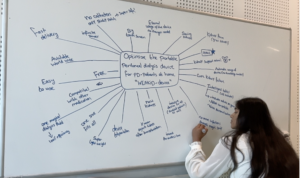
Student Pooja Tika working on her capstone project focused on redesigning the portable peritoneal dialysis device
Capstone project Pooja
“Working on the capstone project focused on redesigning the portable peritoneal dialysis device – a home treatment that uses the lining of the belly to remove waste products from the body when the kidneys no longer work properly – showed me how important an interdisciplinary mindset is when looking at the medical device. We had to balance technical performance with comfort and usability, which we learned with our brainstorming sessions during the workshop. The workshop helped us step away from immediately searching for the “right” solution and instead explore possibilities first. It allowed us to step back from the technical details and focus on the real needs of patients at home. I realized then that creativity was not an extra step, but a necessary part of thinking about the ideas of redesigning the device to be both technically improved and truly user-friendly.”
“The FCT workshop itself also challenged my expectations. Rather than simply discussing what creativity means, we actively experienced different ways of thinking. We started with warming-up exercises and small brainteasers to get into a creative mindset and then moved into exercises like wishful thinking and association. Here we had to look at the problem from a more playful angle; for example, explore what we could do and/or make with a thousand yoghurt spoons. While it sometimes felt unrelated to our capstone project, I gradually noticed that creating some distance from the problem made it easier to approach it from new angles.”
The brainteasers at the start were a great way to get everybody in the right creative mindspace.
“Personally, I found the workshop refreshing because it gave space to step out of the usual capstone mindset. I liked that there was little pressure to get the “right” answer immediately, and that ideas could first be “wild” before becoming more realistic. One exercise that particularly stood out to me was the Wishful thinking warming-up, where we imagined solving our problem without any practical limitations. That made it easier to move away from realistic constraints for a moment and come up with bolder ideas. Another exercise was the Object Association activity, where we had to choose a random object and relate it to our capstone project. It stimulated us to make connections we would probably never have considered during a normal brainstorming session.
FCT allowed us to really practice creativity in a way where anything goes. There was little to no judgement to all the generated ideas.
“From this workshop, I learned that creativity is not something separate from science; it is part of how you approach complex problems in a smarter way. It gives us the openness and confidence to tackle new challenges. Additionally, I appreciated the freedom to experiment without immediately being judged on whether an idea was realistic. For me, that was perhaps the biggest lesson of the workshop.”
Creativity is not about waiting for a brilliant idea to appear, it is about creating an environment in which ideas are welcomed, explored, and improved together.
Moderator’s perspective – Michèle Gerbrands
Michèle reflects on the conditions you need to take into consideration when moderating the FCT workshop. “Moderating this workshop is really fulfilling when you see that students are becoming aware of the added value of brainstorming techniques for their project. The FCT workshop is therefore fitting to create a learning environment where students can explore the techniques and reflect on the added value. In the Appendix you can find additional exercises and tips to create the conditions to facilitate students in discovering their own creative abilities.”
Time and pro-active start
“In my experience you need the full 4 hours for this FCT workshop to align the theory, enough time to do the exercises. Also take short breaks so students can recharge and reflect on this relatively new competence. To ignite energy levels, you can consider at the start of the workshop offering a more physical creative exercise.” In the Appendix an example physical creative exercise is provided.
Thinking in patterns
“As previously mentioned, students must become aware that they are creative as human beings. Besides this, you can also use brain teasers to let students experience this in daily life, we tend to think in patters and that these patterns can stand in the way of our creativity. You can use brain teasers to let students reflect on their own pattern thinking.” In the Appendix two example brain teasers are provided.
Warming-up
“Students can be a bit reluctant in applying brainstorming techniques; they need to build confidence. Warming-up is an important step in getting in a more creative mindset and also a great way for students to practice the techniques outside the scope of their own project.”
In the Appendix more information on warming-up exercises can be found.
Rules for brainstorming
“We usually use the term brainstorming out–of–the–box when students get acquainted with these brainstorming techniques. It is an incentive to invite the students to share every thought and idea that pops-up. Students can be reluctant at the start due to the fear that a “crazy idea” might be judged by peers. Avoid judging or criticizing any idea, is one of the rules for brainstorming when brainstorming techniques are applied. Therefore it is important to practice with students to open up and let them experience that an out-of-the box idea might trigger another team member to come up with an idea. This could create flow in a brainstorm or even might lead to feasible solutions. Practice the rules for brainstorming with students frequently by appointing one rule to each student. Use warming-up exercises and ask students to reflect on the rules after the exercise is completed.”
It is all about practice
“Exploring brainstorming techniques, and discovering their added value, requires practice. The FCC tool introduces two techniques, but many more are available. There is a rich selection of brainstorming techniques from which you can choose when designing your own workshop. On the internet, search for “creative ideation techniques.” Select techniques that align with the learning goals and intended outcomes of your educational context, for example wishful thinking.
Tips on reflective exercises with students
- Collect several quotes from different well-known people on creativity. Print the quotes on small cards (like a card deck).
- Make groups of 4 or 5 students and ask each student to select their favorite quote. Instruct them to share and reflect on the selected quotes in the group. End the session plenary by asking two or three students to share their quote.
- Discuss with the students how brainstorming techniques can have added value within their capstone project.
- A few examples of quotes:
- “To raise new questions, new possibilities, to regard old problems from a new angle, requires creative imagination and marks real advance in science.” – Albert Einstein
- “There is no doubt that creativity is the most important human resource of all. Without creativity, there would be no progress, and we would be forever repeating the same patterns.” – Edward de Bono
- “You can’t use up creativity. The more you use, the more you have.” – Maya Angelou
Learning Outcomes
The FCT workshop helps students develop creativity as a competence they can actively use when working on complex challenges. While creativity is the central learning outcome, the workshop also supports openness, collaboration and reflection.
- Applying creative thinking techniques (Acting) – students learn that creativity is not limited to artistic expression by practicing different brainstorming and association techniques, to generate a broad range of ideas before evaluating their feasibility.
- Breaking habitual thinking patterns (Acting) – students become aware of familiar thinking patterns and practice moving beyond them to explore unexpected possibilities.
- Openness and Learning Mindset (Being) – students practice suspending judgement, becoming more comfortable with uncertainty and exploring unusual ideas before evaluating their feasibility.
- Creativity as co-creation skill (Collaborating) – students practice creating conditions where ideas are welcomed without judgement, allowing them to build on each other’s contributions and develop ideas together.
Short biographies

ing. Michèle Gerbrands MA is an educational innovator and researcher in the field of Life Sciences, with 25 years of experience in higher education and expertise in community-engaged learning, as well as interdisciplinary and transdisciplinary education. She has designed and implemented numerous challenge-based learning courses and, through guiding students in learning communities, has developed a clear vision on education for sustainable futures. Michèle combines creative thinking with a strong commitment to designing learning environments that are rooted in students’ needs, empowering learners to collaborate and address complex societal challenges. To share her expertise in CBL, together with Sabine Uijl, she designed a CBL game, From playful dialogue to purposeful design
Email: m.c.gerbrands@umcutrecht.nl
LinkedIn: https://www.linkedin.com/in/mcgerbrands/

Pooja Tika is a master’s student in Cardiovascular Health and Disease at Utrecht University and a firm believer that creativity is a core competency for every scientist. While her academic focus is on the clinical translation of cardiovascular research, her deeper interest lies in the “how’’: how do we prepare future scientists to collaborate across disciplines, think creatively, and tackle complex healthcare challenges together? Through the Translational Life Sciences profile, she discovered that meaningful innovation does not come from scientific knowledge alone, but from bringing together different perspectives, ideas, and people. She hopes to bridge science, creativity, and collaboration in future healthcare.
Email: pooja.tika99@gmail.com
LinkedIn: www.linkedin.com/in/pooja-tika-1a3ac0901
