
The Visual Narratives tool in the Graduate School of Life Sciences, UMCU
At Utrecht University, master students who are participating in the Graduate School of Life Sciences, are offered a creative challenge in their education: the Visual Narratives tool from the Transition Makers Toolbox. Transition Maker Michèle Molendijk, PhD talks about the background of the programmes in which it is offered, the challenge itself and the reactions from students.
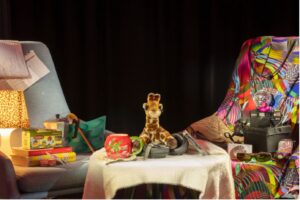
An example of an installation created by students; A Day in the life of this giraffe with on the left the past (work, reading, coffee/tea.) the present in the middle and the future (party, colours, creativity) on the right.
The profiles of the GSLS
Both Life Sciences & Society (LSS) and Translational Life Sciences (TLS) are profiles within the Graduate School of Life Sciences (GSLS) at Utrecht University. Second-year students from all Master programmes of the GSLS can choose one of eight profiles, based on their interests, of which TLS and LSS are two options. Both profiles span the last six months of the academic year and include a capstone project in which groups of 2-4 students work on a challenge. Additionally, reflection and giving and receiving feedback are a big part of both profiles. Albeit slight differences in the structure and content, the main learning goals of both profiles are collaboration, taking on various perspectives, communication and reflection.
The Visual Narratives tool
Ing. Michèle Gerbrands, MSc and Fleur Boelens, MSc designed the tool “Visual Narratives” for the Transition Makers Toolbox. This tool, also known as the Photochallenge or Creative challenge, aims to introduce the learning goals of the profiles to the students in a creative manner. Firstly, students will do short creative exercises to get acquainted with their own creativity and to open their minds to thinking outside of the box (supervised by a creative professional). Finalizing this introduction, the students are told to write a short random story of a few lines. This story will serve as the base for the challenge.
After this individual introduction, the students are divided into teams of 6 and must brainstorm to build a consensus narrative from all their individual stories. Then the students will build an installation that tells their narrative, from various objects they have brought themselves or were offered by the staff.
The building of the installation is done in multiple rounds, after each round the students receive feedback from the staff that they need to incorporate into their installation. One of the rounds also consists of a Wildcard, to introduce uncertainty and surprise to the challenge. In the class of Michèle Molendijk, PhD, the students were told to remove 3 objects from their installation without changing their narrative (less is more). Afterwards they had to take two objects from the objects other groups discarded and add it to their installation without changing the narrative. After the final round of feedback, a professional photographer (part of the staff) took pictures, and they shortly presented their narrative and pictures to the rest of the group. Later that week, a debrief of the challenge was organized for each profile to reflect on the challenge.
What surprised me was that I am actually creative.
Value of the tool for students
Within this challenge the students get introduced to all the core learning goals of both profiles. These include, collaboration, perspective taking, resilience, receiving feedback and reflection. Due to the creative nature of this challenge the students are forced to think outside of the box and clearly communicate with their teammates. While the students do not recognize the value of the challenge in the moment, they can clearly link the learning goals of the profile to the challenge in the reflection debrief later in the week. Additionally, this challenge allows for community building at the start of each profile and gain insight into their own way of collaborating. As such, it allows skill development in several of the IDG dimensions.
In the beginning I was a bit resistant going out of my comfort zone, but later I could embrace it.
Experiences of the teachers
The Visual Narratives tool is an alternative way to introduce students to core skills they will need throughout the profiles. Since it is such an unconventional way of teaching, it does take quite some preparation time. This includes the reservations of an appropriate location (preferably an inspirational room and not a classroom), finding and instructing creative professionals (e.g. photographer) and collecting items that the students can use for their installations.
While the preparation can take up more time than regular education, the day itself is relatively calm. The students will work independently, and the professional creatives are the first point for questions and feedback.
It is amazing to see the students going from apprehension towards such a creative and challenging educational setting to fully immersing themselves into the experience. Additionally, the debrief afterwards is very valuable to gain insights into the experience of the students and to let them reflect on the value of the challenge.
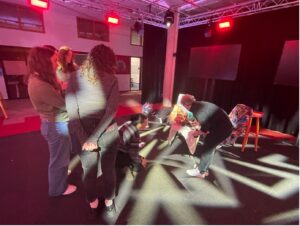
Student team working on their installation.
Learning outcomes
Learning outcomes
This tool contributes to multiple key learning goals – some upfront, others woven in more quietly. As such, it aligns with all five IDG Dimensions.
- Collaboration (Collaborating) –the students work in teams and with others they don’t know well yet. In that process (and during the debrief) they will gain insight into their own preferred collaboration style and roles.
- Open and learning mindset (Being) – because this is not average education, the students need to be open to this new experience, which requires an open mindset.
- Creativity and thinking outside of the box (Thinking) – the students are clearly impressed by their own creative abilities by the end of the challenge.
- Receiving and incorporating feedback (Relating, Collaborating)– students need to be open to feedback of their peers and the staff to successfully build the installation.
- Dealing with uncertainty and unexpected events (Thinking, Acting) – the wildcards introduce a level of surprise and uncertainty to the challenge that requires the students to rethink their installation and boosts resilience and flexibility.
- Reflection (Relating) – throughout the challenge students need to reflect on their choices for their narrative and installation and afterwards the students reflect on the challenge and link it to the rest of the profiles.
- Perspective taking (Being, Thinking) – the students need to form a consensus narrative and thereby need to take the perspective of their peers. Additionally, the installation should be viewed from different perspectives, which they learn throughout the feedback rounds.